Dapple
Don QuixoteDapple, Sancho Panza’s donkey, is more than a mount: he is the companion Sancho repeatedly protects, depends on, and recognizes as part of his own life. His story runs beside the adventures of Sancho and Don Quixote, joining comic mishaps to moments of hardship and making the practical costs of their travels visible. Dapple is stolen and recovered, frightened into flight, prepared for journeys, and finally welcomed home with Sancho; their bond is expressed most plainly when Sancho embraces him after abandoning the governorship of Barataria.
Identity and Place in the Travels
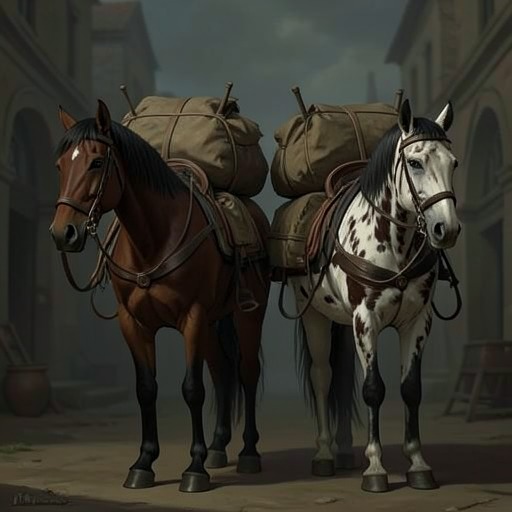
Dapple belongs to Sancho, who relies on him for travel and for carrying equipment. The donkey’s importance is established through recurring practical details: Sancho rides him on the road, prepares his saddle and supplies for an excursion, and uses him to carry Don Quixote’s armor when the defeated knight travels without it. Their companionship is not simply a matter of transportation. Sancho treats Dapple as a friend and partner in hardship, and repeatedly measures the uncertainties of his own life against the donkey’s presence.
Dapple also anchors the contrast between Sancho’s everyday needs and Don Quixote’s chivalric expectations. Sancho worries about food, the animal’s safety, and whether he will have to walk; Don Quixote is ready to interpret an apparent theft as an adventure and to promise restitution through some grand gesture. The donkey’s ordinary function keeps the journey grounded in the labor of carrying people and possessions, even when the travelers interpret events through the language of romance.
Theft and Recovery
Sancho recounts that Dapple was stolen during the travelers’ earlier flight into Sierra Morena, after their release of the galley slaves and an encounter with a funeral party. The men had taken shelter in a thicket and fallen asleep from exhaustion. Sancho slept on Dapple, while the thief set stakes beneath the four corners of the pack-saddle, leaving Sancho temporarily supported above the ground as the animal was taken from beneath him. When daylight came and the stakes gave way, Sancho fell, discovered Dapple missing, and lamented the loss. He later saw the donkey again while traveling with Don Quixote: Gines de Pasamonte, the escaped galley slave whom they had freed, was riding him in the dress of a gypsy.
The account becomes a small instance of the book’s self-conscious play with its own history. Sancho notes that the narrative appears to describe him riding Dapple before it has related the donkey’s return. He cannot explain the discrepancy, suggesting that the historian or printer may have made a mistake. The episode thus gives Dapple two roles at once: he is the object of a concrete theft and recovery, and the focus of a continuity problem that the characters themselves notice.
A later encounter repeats the threat of losing him, but turns it into a brief theatrical scare. As a troupe travels toward a village festival, a performer in a comic devil’s costume, carrying inflated bladders on a stick, frightens Rocinante. The horse bolts and Don Quixote falls. Sancho leaves Dapple to hurry to his master, and the performer uses the opportunity to mount the donkey and drive him away with noise and blows. Sancho is torn between helping Don Quixote and watching Dapple flee, but chooses his master first. Don Quixote offers to recover the animal and even to replace the loss with one of the cart’s mules; before that plan is needed, the performer falls from Dapple and the donkey returns to Sancho. The threatened separation ends without a lasting loss, but reveals how deeply Sancho feels each danger to his companion.
Companion on the Road
Dapple accompanies the travelers through departures and new expeditions. When Sancho and Don Quixote leave Don Diego’s house, Sancho rides him; for the journey toward the Cave of Montesinos, Sancho saddles him and prepares the provisions. These preparations are modest beside Don Quixote’s extraordinary aims, but they are essential to the practical continuation of the adventures. Dapple bears the necessities that make a long road possible.
Sancho’s familiarity with Dapple also shapes how he speaks about the other animals on the journey. When a traveler hesitates to ride beside Rocinante, Sancho assures him that the horse is exceptionally well behaved, while recalling that the one time he misbehaved, Sancho and his master suffered for it. At this encounter Don Quixote rides without his helmet, which Sancho carries in front of Dapple’s pack-saddle. Dapple is thus part of the traveling arrangement even when the conversation concerns Rocinante: he carries the equipment that the knight is not wearing and remains central to the squire’s management of their road life.
After Don Quixote loses to the Knight of the White Moon, Sancho refuses the idea that he should make long journeys on foot. He proposes riding Dapple while Don Quixote’s armor is hung on a tree as a trophy, and Don Quixote accepts the practical arrangement. Later, when the two leave Barcelona, Sancho is on foot and Dapple carries the armor. Across these reversals, the donkey supports the journey even when Sancho cannot ride him or when the knight’s defeat has altered their plans.
The Governorship and the Return to Dapple
Sancho’s appointment as governor of Barataria takes him away from the road and from the familiar life he shares with Dapple. After a staged nighttime attack and an exhausting ordeal, he resigns. Once he has been helped to his feet, he dresses, makes his way to the stable, and embraces Dapple, kissing him on the forehead. The gesture comes before any return to the Duke and Duchess. Sancho recalls his earlier days with the donkey as happier and less burdened, when his concerns were limited to mending the harness and feeding him. He contrasts that life with the anxieties that accompanied ambition and office.
The donkey is also Sancho’s companion through the consequences of the governorship. During the journey back, Sancho and Dapple fall into a pit. Sancho fears that neither will be found, calls for help without being heard, and attends to Dapple, who is lying on his back and can barely stand. He gives him bread from the provisions that survived the fall. When Sancho discovers a narrow opening into a larger cavern, he returns to Dapple, widens the passage by removing clay, and leads him by the halter through the underground space in search of an exit. Their eventual return is therefore not merely Sancho’s escape from a bad appointment: it is a shared passage out of danger. At the castle, Sancho puts Dapple in the stable before presenting himself to the Duke and Duchess.
Homecoming and Narrative Significance
Dapple remains beside Sancho as the pair return to their village. On the way, Sancho insists that the donkey is part of his account of the journey; in Barataria, he had left the island with no escort except Dapple, and the pit had left them dependent on one another. At the village entrance, Dapple carries Sancho’s armor bundle and wears the buckram robe painted with flames that had been given to Sancho at the Duke’s castle. A mitre has also been fixed on the donkey’s head, creating an incongruous display that draws the boys’ attention. The costume turns remnants of the castle’s staged entertainments into a visible part of the homecoming.
Sancho’s wife and daughter meet him, and Sanchica Panza leads Dapple as the family makes its way home. The detail completes a recurring pattern: Sancho may aspire to a governorship or be swept into the elaborate inventions of Don Quixote’s world, but his return is organized around familiar people, his donkey, and the practical business of getting home. Dapple’s appearances do not make him an independent actor in the human conflicts; instead, his steady presence gives continuity to Sancho’s changing fortunes. Theft, flight, burdens, and the pit threaten that continuity, while Sancho’s repeated care for him restores it. Their companionship is one of the novel’s clearest measures of what Sancho values when grand ambitions fall away.